Showing posts with label Lapland Bunting. Show all posts

Saturday, 14 November 2020

Early November second half...Caspian and Dusky

The second half of my stay stay started fairly quietly, with the 6th producing a Velvet N, 17 Crossbill S, 21 Whoopers and a Marsh Harrier. 

Don't get Twite back home - cracking things

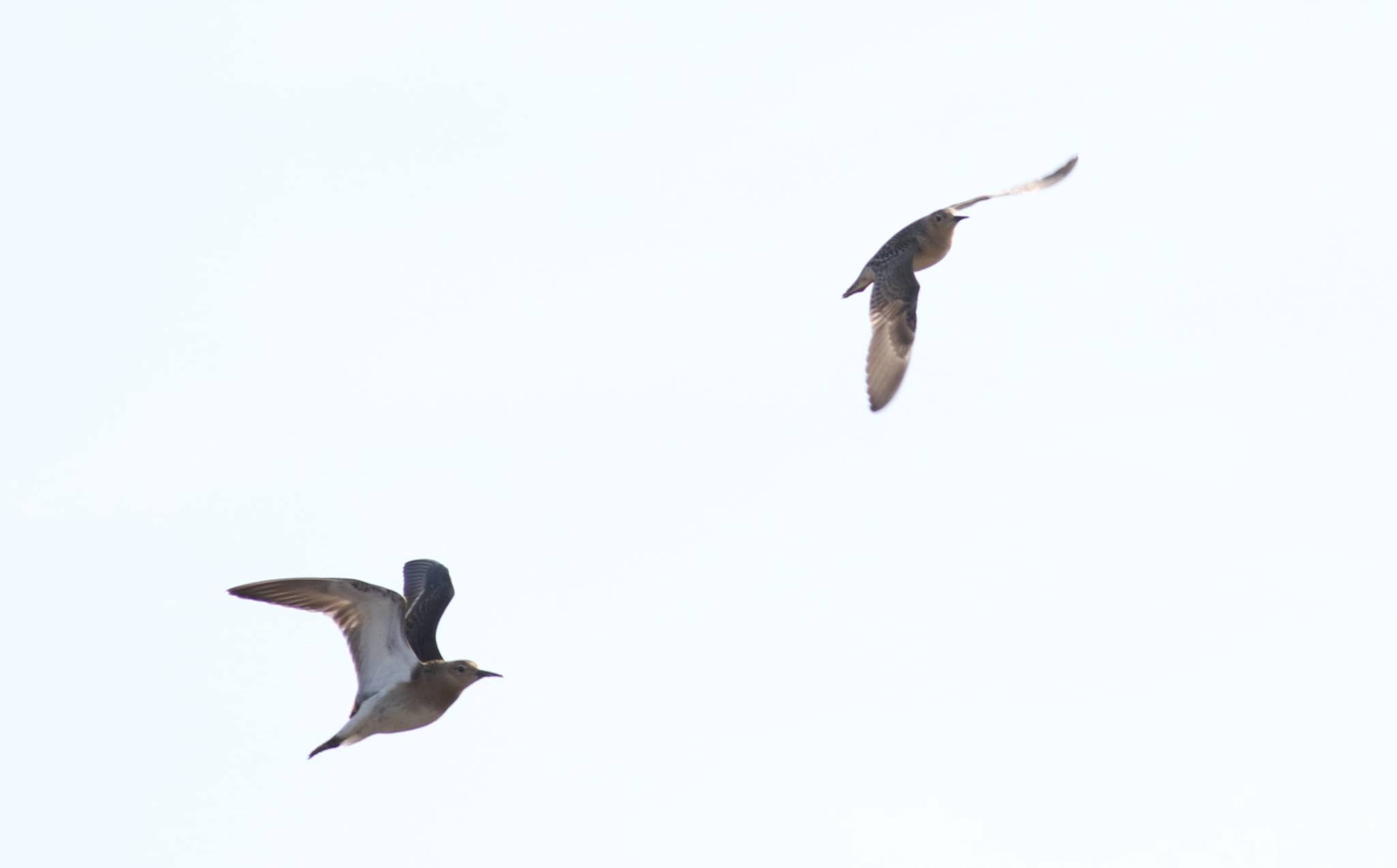
The 7th was better, with 84 Eider N, 3 Lapland Bunting S and a few more thrushes in. Best though was a 2w Caspian I picked up fairly distantly offshore amongst gulls around a fishing boat. Initially unsure whether it was a 1w or 2w, I picked it up on the clean rump contrasting with the black tail band, pale underwing and overall long-winged jizz. It eventually came closer and landed on the Steel a way off, allowing the age to be confirmed and other features secured such as covert and tertial patterns, long legs and slopping head/parallel sides bill with negligible gonies angle. It flew south and Mark caught up with it loafing off Seaton Point. The 2nd confirmed one I've had, definitely different to the one in September on structure.
Won't find any Herrings with a tail and underwing like that...

...nice shawl and bill too...

...and very long-winged! 
(Plus look at the window and greater covert pattern)

The conditions for the 8th looked the best of my stay. Fog, maybe rain and SE winds all pointed to an arrival. From first thing an arrival of sorts was apparent with thrushes, mainly Blackbirds passing over unseen in the fog at Seaton Point. More Woodcock were new in, I had 3 throughout the day, but Mark had 5 on the Steel alone and I joined him for a while waiting for things to come in. There were quite a few ducks moving N, but lots were probably missed in the fog. Although more thrushes were arriving throughout the morning, there seemed be a lack of anything else until I a found a 1w male Black Redstart on the undercliff halfway between the Steel and Boulmer.

Smart bird in typical setting

Dodging me, runners and dogs

It showed well, but I wanted to press on back to Seaton Point to see if anything else had arrived. A pale redpoll, probably Mealy dropped in briefly along the coast but soon carried on inland. The first few bushes at Seaton Point revealed nothing new from the morning, but at the south end of the mound I found a distinctly pale Chiffchaff, which after initially a bit of a run around showed well and proved to be a rather smart Siberian, albeit silent. Only my 2nd ever, and first at Boulmer, it was a really nice bird, very pale underparts, all black bill and legs, rather pale diffuse super and green-grey upper parts. It remained silent but showed down to a few feet in the fog, often feeding on the ground - a real treat. 

First views - paaaaale


Probably the closest of any Chiffchaff I've ever had

Mark's comment on this pic - "the most spherical bird I've ever seen"

A Lap Bunt flew over, probably in-off as I was watching the Chiffchaff, and whilst walking around the point trying to find a Dusky Warbler (there'd been an arrival of 6 at Spurn alone) I flushed a silent Jack Snipe from the path, a patch tick (number 187). Otherwise there didn't seem to be too much in other than Blackbirds, so I went back for seconds of the Chiffchaff, where I was joined late on by Mark.

The 9th again looked like there might be some arrivals, and in fact, starting out at the Steel there were more thrushes, again mostly Blackbirds coming in off, some dropping in. The rain early on in the morning gave the most pronounced movement, but it was clear birds were coming in all day, my ability to see and hear them dependant on the density of fog at the time. Ducks were also moving in good numbers, with counts of 340 Wigeon, 83 Eider, 9 Shoveler, 50 Teal, 6 DB Brents all N, plus a BT Diver that way too. I also picked up 3 Slavonian Grebes fairly close offshore sat on the sea, and eventually joined by a group of up to 8 Goldeneye, were only my 2nd patch record. Pom Skuas, 2N 1S were my first for a while, one juv showing quite well chasing Herring Gulls.

Straight from the phone

I headed down to Seaton Point to look for the anything new in there and the Chiffchaff again. There was no sign of the latter so I began a more concerted check of the caravan site than the day before, as there were very few people around. Blackbirds were everywhere still, as were Song Thrush, but there were seemingly no new in crests or warblers.

At about 1pm, I was walking up the central track on the south side of the caravan side when a small bird flew into a hawthorn briefly, before zipping across behind a caravan. For the split second I got on it, it looked like a small Phyllosc, and did I hear a tack or was I imaging it? I scrambled up the hill to see if I could locate the bird, and waited for 5 minutes. There was no sign, so I put it behind me, probably a Wren, and continued up the path. 30 seconds later, another couple of tacks? I turned and listened intently, only Wrens could be seen and heard, was I going mad? I continued along to the eastern end of Seaton Point, before routing back west along the beach. I then had the choice of whether to continue along the sand or go back along the already beaten path and look again for the possible Dusky...

Nearing where I thought I heard tacks last, a small dark bird flushed across the path in a small hawthorn - on raising my bins I was met with a dark bird flicking around to reveal a striking super...Dusky Warbler! It flicked along into some bracken where it began 'tutting' away, so I decided to grab my recorder out of my pocket in order to have something to go back to. It wasn't still for long and I had to run across the bracken/hawthorn covered mounds to keep up with it. After being sure I'd recorded some calls, I put the news out, locally first to gauge opinion on whether it would be appropriate given the current situation to put it out wider. After being reassured, I stuck it on the the Northumberland group with a pin, by which time I had completely lost the bird.

I knew Mark was on his way, so set back about trying to find it again. Luckily I did so when it flushed from the side of the path seconds before Mark arrived, after some waiting the bird again flitted from bracken sea to hawthorn, mostly just giving flight views and calls. John joined myself and Mark later in the evening and also managed a short view, but it really was a tricky bird to pin down, the only pic I managed being an awful flight shot. I've joint found one before at Spurn, but it was nice to find one on my patch and add to the Boulmer area list again - now 248 we believe!

Poor quality, but you get the idea

Still present the next morning, I finally managed to get a shot when it flew into the bottom of a hawthorn for a couple of seconds after I had followed it for around 30 mins through the bracken. Stewart Sexton said he was going to come down for it during his lunch break, so I headed off to check other areas with the intention of helping him look later. A couple of Lapland Bunting seemed fairly settled around the field near the mound, flushing out a few times but always returning. Thrushes had definitely thinned out though, so I went back a bit earlier than expected to look for the Dusky with some other birders. When Stewart arrived we again found it fairly quickly, but for the most part it only showed in flight, once however flicking around nicely for probably 5 seconds in a hawthorn, allowing me to get some better shots and Stewart to get a view good enough to produce the amazing sketch/painting seen below.

The typical panicky bin-raising view - would my camera make it?

Finally!

Mid flick 

Stunning from Stewart
http://boulmerbirder.blogspot.com/

The day also brought a couple of Velvets N and 2 Bonxie south, plus a rather cheeky patch tick Hooded Crow which I picked up in flight over Howick from the clifftops south of the burn, before it landed on the TV aerial of Seahouses Farm. The bird has been around since the Summer, so I was glad to catch up with it, albeit it extreme distance. 

Fogged up, a Lap Bunt nonetheless

There ended my early November stay, 11 patch ticks which was way more than I thought, plus several nice finds. 189 in just under 7 months for me at Boulmer is it seems a new year record for anyone on any patch in the county - I'm fairly pleased with that! (Thanks to Stewart for doing some digging)

The target now has to be 195, I think 200 will be too much of a stretch, but who knows! I still have a few 'easy' things: LT Duck, Treecreeper, Nuthatch, and then when you tally in white-winged Gulls, a couple more geese/swans, scarcities or rarities and maybe a cold snap, you never know I guess. Will be nice to get past 190, I never thought that would be on the cards back in September when I was eeking out birds trying to reach 160.

Friday, 30 October 2020

Mad migration and more in September

 September started without headline, light vismig added Redpoll to my patch list, before things turned serious on the 3rd when Mark had huge numbers of birds, mostly Hirundines moving south late morning. Good looking conditions on the 4th got me out before work - overcast cloud and SWerlies and brought 4247 Meadow Pipit south in just over 90 minutes. Birds were streaming past on all fronts, decent numbers dropping in to feed or rest momentarily along the beach and path, it was akin to a fall of thrushes with birds flushing from every patch of foliage. A good supporting cast of Hirundines and finches were moving south too, but I concentrated on the Mipit spectacle, Ben noting the huge movement too from Seaton Point, easily the biggest he'd had at the site.

Chase on.

A combined watch between myself, Ben and Mark on the morning of the 5th yielded an estimated 9000 Mipits south from 0700-0930 - definitely slower passage than the day before, so shows how many I missed without the extra eyes! Nice extras included a Harrier sp distantly south at Sea (Hen or Marsh), Osprey S, 2+ Merlin, Marsh Harrier, Peregrine, GND S and a site first Jay seen by Mark which I caught up with the next day. 38 Pinkfeet (new), 19 Sooty and an LT Skua were notable on the 6th, but vismig had dropped off mostly. New for the patch however was a cracking juv Little Stint which I reckon was probably in-off as it flew onto the shoreline of the Steel fairly late-on during a watch on the 7th, calling as it did so!


Things were fairly standard until the 16th, when conditions looked good for another seawatch: early doors was decent, although conditions hampering things a little for me, with 8 Sooty, 22 Manx, a few Skuas and duck, the highlight being 4 Pochard N, also seen by Mark and Stewart at Cullernose, proving to be just the 2nd patch record. Intriguing news came from Low Newton of a Buff-breasted Sandpiper briefly on the scrapes, but I had work to get to. Checking my phone late afternoon, I could see the sea had definitely got going with multiple Sabs being seen around the county, but most gripping of all, a Leach's Petrel N and the Buff-breast at Seaton Point! I grabbed my gear, raced down, and after about 40 minutes had finally found the BBS which was showing nicely. Unfortunately, despite my best efforts of half-scanning the sea whilst looking for the BBS, I had undoubtedly been on site when the Sabine's Gull Stewart had N past Cullernose went past, so feeling aggrieved, spent a few minutes watching the yank before getting to a vantage point for a seawatch. The tide was going out, I wasn't very high and passage was starting to slow, but I persevered - the Petrel which sheered up over a trough about 1/3 distance nearly knocking me back! A big thing (for a storm petrel type), stiff winged and sheering regularly with obvious pale covert bands, it was immediately recognizable as a Leach's: I was able to stay on it for about 5 minutes, being the best opportunity to study the species I've ever had as it slowly worked it's way north inside the big troughs. After the bird earlier in the day seen by Clive, that was the 3rd site record, so it was even more of a surprise when I picked up another 10 minutes later, slightly further out and harder to stay on, but again slowly tracking north. Supported by 2 Blue Fulmar north (1 almost purple in colour it was that dark), 10 Sooty and 2 Velvets it was another great little watch.


The 17th was another really good day, and when writing out the summary message of the morning for the Whatsapp group it really dawned on me just how varied it had been. The sea was great, but unfortunately light wasn't on my side, as a fantastic passage of 51 Sooties N, 86 Manx N, 98 RTD S, GND N, 3 Grebe sp N (prob Slav), 674 Pinkfeet S, 73 Brent N and hundreds of ducks, mostly unidentifiable due to the awful backlighting. During one of my inland scans I picked up a smallish wader coming south, just having reached the cliffs by the stream: it was fairly high and flying like a Tringa, but looked too long and slender to be a Green Sand, and not dark enough. I watched as it u-turned, and appeared to drop onto the beach of all places. Given recent Atlantic weather systems and the fact it had plonked on the beach, Yellowlegs was definitely on my mind, if not then a Wood Sand, so I started a hasty jog with my gear to get a look. Scanning with bins I could see no sign, but a dog-walker usefully flushed it out of the seaweedy area halfway up the beach: it landed again briefly, allowing me to confirm it as a Wood Sandpiper, before it flew south calling. A second site record and one the strangest bits of migration I've ever encountered! The BBS was still around the village bay, alongside a Ruff (new), whilst a Greenshank also went south.

Peachy.


Unfortunately the Boulmer area wasn't able to jam in on any of the passerines that were being found at other sites, and being on 158 for the patch with just a few days left I was wondering if I would be able to get to 160. An uneventful walk to the Steel on the evening of the 18th turned good when I stopped to scan the flock of GBBs that had accumulated in the 2nd field north from the village (same place I had the prob Baltic Gull). I picked out a large 2cy Gull that immediately struck me as interesting whilst head on due to it's stance and jizz. It turned and walked around a little, and it became apparent I was watching a Caspian Gull in transitional plumage between 1st summer and winter. A huge bird, barely smaller than the GBBs, it had dark tertials with a fair amount of white at the tips, dark greater coverts with the typical Casp pattern towards the inners, some grey coming through on the mantle, long thin legs, pale head, a grey shawl and a parallel sided, but fairly hefty bill. Due to the rarity of Casps up here and the fact I wanted to see it's underwing, I put it out as a probable and began taking some video. I watched it till almost dusk before it flew north, pale underwing and neat black tail band seen nicely rounding off the features. The 1st confirmed record for the site after the juvenile I probably messed up in August, and a just reward for my constant checking of the gulls I reckon. I think given the size, structure and the bill that the bird was almost certainly a male.


Birds were rolling in fast: a Red-necked Grebe north with an auk and a Lapland Bunting in-off on the morning of the 19th were both new and took me past 160, whilst my first juv Pom of the year and a GND also went past at sea. My final half-day on the patch before I headed to Lincs was highly anticipated - easterlies, fog, and maybe some rain were forecast. Things started off with a spooned Pom north, a Little Grebe by the village (new) followed by another 2 Lapland Buntings in-off whilst talking to Stewart and John, but things didn't seem to be happening on the passerine front. A Short-eared showed nicely on a post, but as I trundled back towards my car I felt a little deflated given the conditions. Stopping to check the bushes by the bench, the fog had turned into fairly heavy drizzle when a bird flicked into the lone bush opposite the bench. Small, a small warbler or crest, before I even had chance to get my bins up the the distinctive call of a Yellow-browed Warbler exploded from the bush several times. I got onto it, took some record shots and then watched as it flicked into the sycamore behind where it began feeding. Spurred on, I checked the other bushes around, and it did seem like some other bits were new, but I had to get off down the A1.


In exactly 5 months I'd reached 163, plus a few sub-species, missing several things along the way too. At the time of writing, the Boulmer team and visitors have managed to add 13 species to the site list so far this year, taking it to 249 - a way behind other coastal sites but definitely catching up fast! A cracking end to my first stay at Boulmer, I ended up being back several times over the course of the autumn, which I'll cover in the next post. 

Red-eyed Vireo, Seaton Point 15/10/22

 A short write-up of what will probably be my find of the year before the easterlies hit midweek. For the past two weeks, a Nearctic passeri...