Showing posts with label Redstart. Show all posts

Monday, 6 June 2022

Post May update - Pallid Swift etc

 A little into June, and already more to write about, but here's my #LocalBigYear writeup for the month of May. 

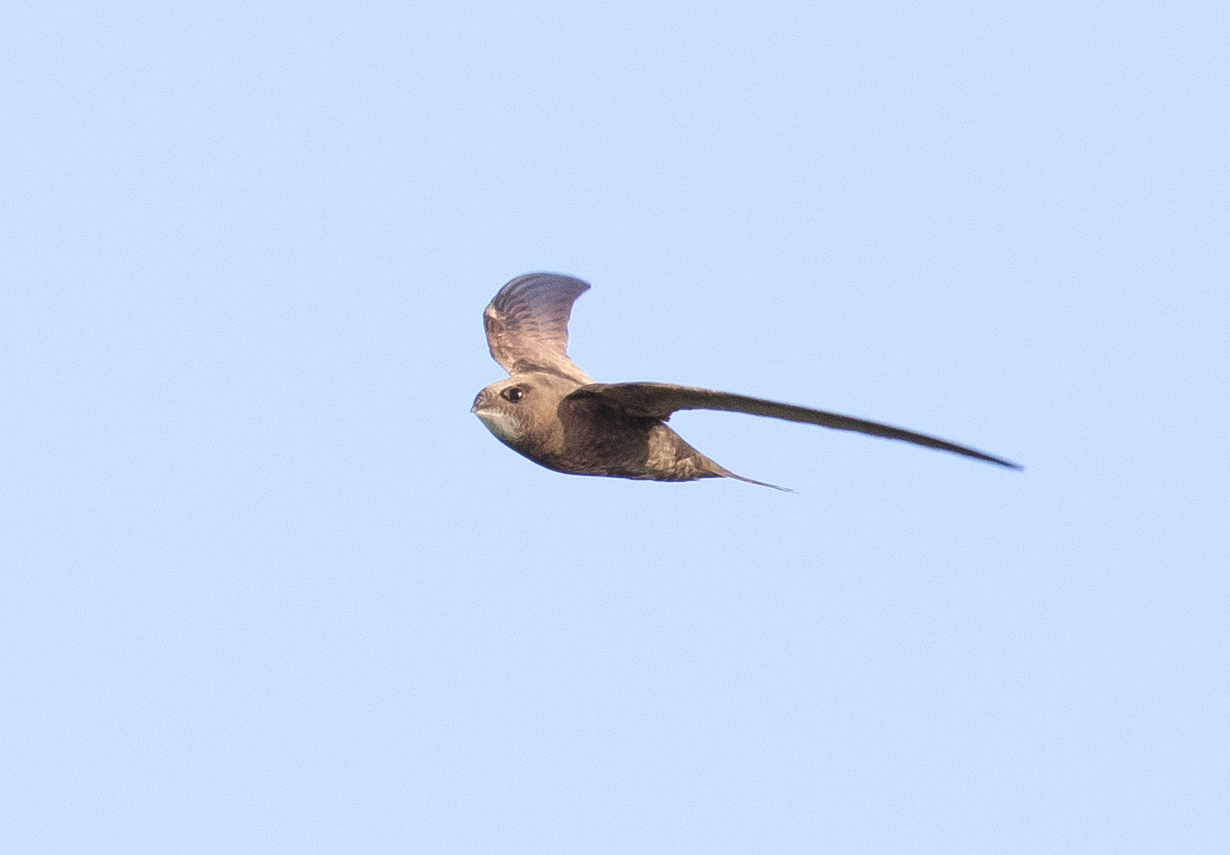
Starting the month on 157 and finishing strongly on 172, it was a strange month, highlighted by a couple of really good days. The highlight was undoubtedly the Pallid Swift I had go south on a pre-work early morning visit on the 18th, detailed below:

A wander around Seaton Pt, although fairly quiet, always felt like it could deliver something good, with a steady southerly passage of Swifts and Hirundines, and the odd grounded warbler. Whilst walking back to the car at 0655, I noticed a Swift coming south fairly low and on it's own. Straight away it looked a little different from the 29 Swift I'd had go past so far, and my initial looks through bins was to check it wasn't an Alpine, as it had a slower flight style and appeared bulkier: it obviously wasn't and as it was now getting close I went for the camera and rattled off some shots as it flew by. A distinct memory I have of the bird on the initial views was the flat glides, and generally less erratic motion, which then made it easier to track in my viewfinder and gain some good shots.

On checking the back of the camera, I straight away noted some features I associate with Pallid - a scaly body, brown tones and general bulkiness. Wanting to get some feedback before work and give others a chance further south, I stuck some BOC's out and drove home to get ready. Initial feedback was decent, but caveated with wanting to wait to see the processed images - understandable given the BOC's did indeed make the bird appear warmer. There's far less identification documentation on adult Pallid Swifts than juvs, and so ever since the sighting I've been delving through image banks to further my understanding - all the feedback I've received subsequently has been pro-Pallid, and subject to acceptance, it would be a first for the Boulmer area, and my first BBRC rarity find here.



Bluethroat and Firecrest:

The 16th was eyed up across the East Coast as having potential for an arrival - eastliers and rain for most of the day. A pre-work drenching whilst aimlessly wandering round Seaton Pt was fruitless for me, but Mark dug out a splendid Firecrest by the layby there, somewhere I hadn't managed to do. A bit of a pain to see for me, even more so to photograph in fairly heavy rain, but a patch tick and real scarcity up here.

The worst photo on this blog

On finishing work, news came through of a male Red-Spotted Bluethroat at Howick - after some initial messing around, it showed really well in the evening light for an appreciative crowd. A good one to get and one that I thought I would have to replace from my 2020 list this year. The one decent migrant I did get in another round of Seaton Pt was this Grasshopper which arrived the previous day, and is still present - another patch tick.

Flushed from the path initially into a small bush


Don't really like boring portraits like this normally

Howick Seawatch:

Late in the month, a couple of days of moderate northerlies drew my attention, and for Sunday the 29th in particular where rain was forecast, I reckoned a Stormie was on the cards. Having not seen one in Northumberland, I was unsure when they are first 'gettable' on a seawatch, so asked around with the general consensus being that it was a little on the early side. To maximise my chances, I elected to watch from Howick, a spot that Ben in particular has had some good days from in the past and is much higher than the anything at Boulmer itself. 

Imagine my shock when at 0538AM I picked up a Storm Petrel heading slowly north about a 1/3 out, coming in all the time. Although not mega-close, the views were actually really nice, and if my phone didn't have a cracked camera the phonescope results would have been fairly good I think.

Full 1080p recommended to see anything

As well as the Storm Petrel, throughout the morning I clocked up 9 GN Divers, 170 Manx, 4 Bonxie, 84 Scoter, 5 Goldeneye, 600+ Sanderling and an Avocet all north amongst a good other selection of species. The other highlight was a superb adult Long-tailed Skua which was tracked north from Whitburn - it wasn't all that close for me and Mark, but it was brilliant to see one with a full-on tail.

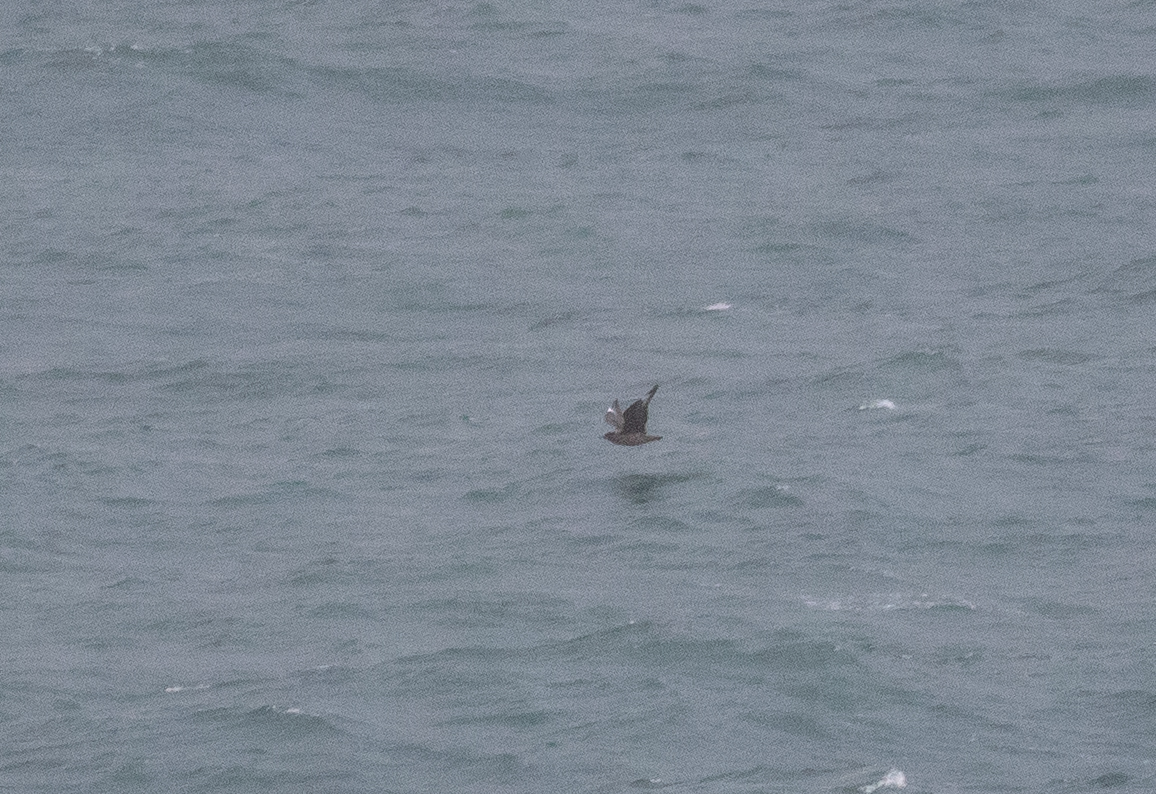
Getting fairly regular now, but still bizarre to get one on a seawatch

One of the 4 Bonxies

All 9 Great Northern Divers will full summer plumaged birds

Other notable bits:

  • Blue-headed Wagtail - a female-type flew south during a vismig on 11th May, picked up in the bins as 'interesting' coming head-on, confirmed as so from flinging the camera in it's direction.

A properly grey head with a bit of a necklace necklace stood out head on in the bins
  • Cuckoo - A patch tick singleton flew south during an evening vismig session on 19th May, mobbed by pretty much everything in the area.
  • Mandarin - It had to be done...when Stewart messaged to say there was a drake on Howick pond on 'Pallid Swift' day, and that he would kindly point it out, I popped across in the evening - certainly one I didn't think was possible in the area.
  • Quail - whilst out looking for Owls at dusk, a few notes burst out of a Barley field near Dunstan
  • Red Kite - distant bird picked up north of Longhoughton from Seaton Pt on 11th May before it dropped down.
  • Scaup - Pair north off Seaton Pt on 2nd May.
  • Redstart and Spotted Flycatcher - Female type on 17th May by the farmhouse at Seaton Pt, with the Spot Fly by Boulmer car park in the paddock.


Looking forward:

Anyone birding within 5km of Longhoughton, feel free to find any of my following, semi-realistic targets for the summer:

  • Ducks - Garganey, Long-tailed Duck.
  • Seabirds - Pom, Black Guillie, Balearic, Great Shear, Cory's, Sab's, Leach's.
  • Passerines - Garden Warbler (I'll get one I'm sure), Tree Pipit, Pied Fly, Green Woodpecker, Crossbill.
  • Waders - Ruff, Curlew Sand, Wood Sand, Little Stint.
  • Yellow-legged Gull.
  • Raptors - Osprey, Hobby, LEO.

I'm sure there's things I've forgotten from that, but they're all doable I reckon. Hopefully the first couple of weeks of June have some easterlies for things like Marsh Warbler and Red-back Shrike, and hopefully some rarities make an appearance. 

Tuesday, 17 November 2020

October flashback - twitches and AGP

 Another backdated post for October, meaning it's now all up to date...

With a couple of days off work, I headed back up on the 2nd of October with the weather looking half-decent for the next day at least. A morning around the Steel and Seaton Point produced and ad Curlew Sandpiper going into winter plumage, a variety of ducks moving north and a Yellow-browed Warbler by the car park at Seaton Point. I had planned if it was pretty quiet to head up the coast to Budle for the Two-barred Greenish, so set off that way late morning. It hadn't been seen for several hours on arrival, and despite up to 3 YBW showing well, it wasn't seen again that day or ever again for that matter - dip!

However, early afternoon a message came through that a Bluethroat had been found at Boulmer, though there weren't any details initially. Myself and Mark who had been waiting for the Two-barred Greenish set off pretty much straight away, and were soon watching the bird popping in and out of the marram grass bordering the beach just north of the car park. I'd failed to walk along there in the morning, instead opting to drive the car across to the Seaton Point car park - very lazy and costly it seems! It was a really nice bird though, a 1st-winter male with some nice blue coming through, and another new bird for the area in an already fantastic year. 8 Velvets, a Pom and a Sooty were nice on an evening seawatch whilst I checked the weather for the next day.


Very nice

Called from further down the coast, only took a few mins

The 3rd starting off with easterlies and fairly heavy rain, which stuck about for mosr of the day. There were evidently some birds new in from the off, with a new YBW by the bench near the village and 3 Blackcap, several Chiffs and a few Blackbird and Song Thrush. Sites in Yorkshire were getting an arrival of crests and thrushes that just wasn't apparent in Northumberland it seemed. Mark had started at Seaton Point, myself at the Steel, and with little really to show, we passed each other in front of the pub at around 11. On reaching the bushes by the mound towards Seaton Point, having had only a couple of Goldcrest on the Steel, Mark the same, they were suddenly everywhere. Groups of 3 were turning into flocks of 10 in front of my eyes, so I messaged Mark to see if he was having the same thing - he was, 25+ on the Steel alone. 

The wave of Goldcrest brought with it more Blackbird, Song Thrush, Robin and Blackcap, and suddenly it felt like there were birds to be found. Unfortunately I only had till the early afternoon, so was in a race against time to get something. A couple more YBW, more Chiffchaffs and Blackcaps were evident but that was all from Seaton Point. Heading back north past the pub, the a couple of  patch tick Redstarts were new in where I had passed Mark earlier, as was a Wheatear and more common migrants. A few Redwing were seen coming in-off, but by 2 I really had to be off, so headed back down the A1, hearing of some really good stuff arriving elsewhere - very annoying! After the 2 day stay I was still creeping forward, reaching 165.


I wasn't planning to be up for a while, but the finding of a Great Grey Shrike, another first confirmed record for the area, saw me back up the A1 on some days off from the 8th. A great day for passage, I started out on the Steel, clocking over 2800 Pinks S, 10 Whoopers (patch tick), 33 Little Gull N, as well as the odd crest and Wheatear about. Heading towards Seaton Point, a Redpoll calling overhead dropped onto a distant hedge: I got my scope on it and was met by a nice pale Mealy, a patch tick and pretty scarce at Boulmer. I found the Shrike fairly easily by the farmhouse, and showed well giving good scope views. After I'd had my fill of that, I jammed in on a Great-spotted Woodpecker in the village (patch tick), and possibly further afield before grabbing some lunch.

Loyal to it's chosen hedge

I decided to spend the late afternoon and evening on the Steel checking the Goldies and seawatching. On reaching the Steel, around 1/2 way through my scan of the Plovers I picked up the semi-resident pale bird, always striking ay first, but just a weird Euro. Towards the end of my scan, on the far edge as the flock was thinning out a bird with weird jizz caught my attention - smaller, slimmer and greyer than anything previously in the flock, I watched it running around and feeding in an almost hunched over manner. It was fairly close to a standard Euro, and the much more prominent super which diffusely reached further to the rear of the head was also a big feature, as were the proportionately much longer legs. I studied the bird for a minute, noting the long tapered look to the rear end and primary projection past the tertials - it was a juvenile American Golden Plover, it had to be!


I put the news out as a probable initially whilst I waited to see if I could see it's underwing, which it duly showed in a brief sortie. It was very active, and spent a lot of time imposing itself on the bulkier Euros. Quite a while was spent videoing the bird on my phone, trying to capture the underwing and other features. As the tide came in the entire flock nudged closer and closer, albeit with the light fading (it actually stood out much more in the poorer light than being lit by the sunset.) Being able to view it for about an hour, I got plenty of chance to compare the two species, at one point the flock flew and I had to refind it, which wasn't very hard. Unfortunately no-one was able to make it down that night, and despite extensive looking over the next few days, it wasn't seen again (more decent passage plus patch ticks Twite and Goldeneye were added the next day whilst looking though!). Another patch tick and first for the area. It was also the first American bird I've found, bit of a landmark and hopefully the first of many. You'll need to be on the full web version to see the vids below.

1080p otherwise it's probably not worth it

Ditto

Conditions for seawatching looked decent from the 13th, when 3 Poms, 7 Sooties, 5 Manx and 30 Little Gull went north, with 225 PB Brents south. The 14th was better for variety though. A morning watch with Mark from the Steel produced patch tick 2xBT Divers and Slavonian Grebes, 8 Arctic, 3 Pom and 3 Great Skua as well an assortment of ducks north. Frustratingly though, with birds arriving elsewhere (Holy Island with some great bits), there seemed to be very little tangibly in at Boulmer. A similar story in the bushes on the 15th, 15 Goldcrest, a Chiffchaff being the highlights, though a Little Auk N was nice (patch tick), and a mid distance Diver threatened to be White-billed, but remained too distant.

BTD (left) with RTD

I eventually broke on the 16th, spending the morning on Holy Island totting up some nice species, but failing to find anything myself. None were lifers, but Brown Shrike, Pallas' and Dusky Warblers were good, although the Bluetail was only found after I had left back down the A1 home. One of these weird looking late autumn Willow Warblers and a SE Owl were the only real bits of interest I bumped into alone.


Back at work a few days later, I was left stunned when I checked my phone to see Stewart's picture of his and John's newly found Desert Wheatear at Seaton Point! A cracking bird and great find, I was left to just hope it would stick till I could next make it up. Thankfully, it did just that, and on the 22nd I was able to come up for the day - a proper dirty twitch but worth it. It was never really close, but gave decent scope views, bringing a steady flow of admirers through the day feeding mostly in the ploughed field opposite the layby. 

Surprisingly tricky to pickup in it's field

A Black Redstart found in the week by Ben was my next stop, and sure enough I picked it up relatively quickly on houses at the north end of the village, another patch tick. It was a female type thing and very brief, but nice nonetheless. I then headed over to the Steel for a spot of vismig as I'd had a few finches going south whilst watching the Wheatear. I was fairly quiet for the most part, until I heard a Crossbill type call from out to sea. I picked up the bird coming in low from the north-east, a big male with a call unlike a Crossbill I had heard before. I always try and set my recorder up when vismigging, but having been walking around I had to grab it out of my pocket, meaning the first few and loudest calls were missed. Thinking the calls I had heard and the bulk of the bird indicated it could have been a Parrot, I stuck it out as such, hoping my recordings would shed some light later...

Certainly chunky, alas

...they did. Common Crossbill, of the British/Norwegian form giving N6 calls (at least the 2 I managed to record). A bit disappointing, but listening to these calls back I still reckon it's not the call I'm familiar with Crossbill making when I've had them moving south most of the Autumn. A bit of a weird one, and probably best to put it down to a lack of experience and naivety of seeing a bulky Crossbill coming in-off.  When I first head it, it had a Chaffinch-like quality, but who knows.

That takes me up to the end of October, the patch list sitting on 178. Bit of a weird order to the last couple of posts but wanted to go over the recent spell whilst it was still fresh. So head back two posts to continue the read...

Red-eyed Vireo, Seaton Point 15/10/22

 A short write-up of what will probably be my find of the year before the easterlies hit midweek. For the past two weeks, a Nearctic passeri...