Showing posts with label Long-tailed Skua. Show all posts

Monday, 6 June 2022

Post May update - Pallid Swift etc

 A little into June, and already more to write about, but here's my #LocalBigYear writeup for the month of May. 

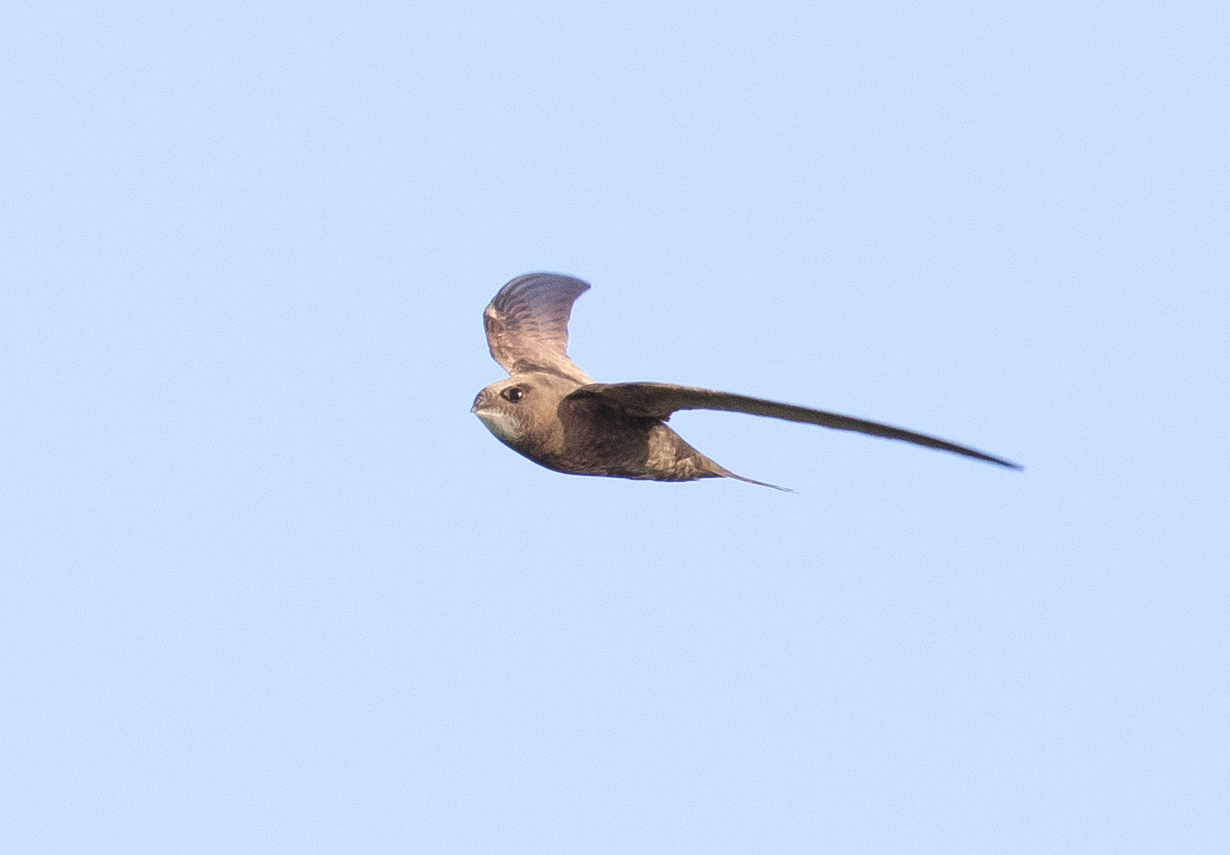
Starting the month on 157 and finishing strongly on 172, it was a strange month, highlighted by a couple of really good days. The highlight was undoubtedly the Pallid Swift I had go south on a pre-work early morning visit on the 18th, detailed below:

A wander around Seaton Pt, although fairly quiet, always felt like it could deliver something good, with a steady southerly passage of Swifts and Hirundines, and the odd grounded warbler. Whilst walking back to the car at 0655, I noticed a Swift coming south fairly low and on it's own. Straight away it looked a little different from the 29 Swift I'd had go past so far, and my initial looks through bins was to check it wasn't an Alpine, as it had a slower flight style and appeared bulkier: it obviously wasn't and as it was now getting close I went for the camera and rattled off some shots as it flew by. A distinct memory I have of the bird on the initial views was the flat glides, and generally less erratic motion, which then made it easier to track in my viewfinder and gain some good shots.

On checking the back of the camera, I straight away noted some features I associate with Pallid - a scaly body, brown tones and general bulkiness. Wanting to get some feedback before work and give others a chance further south, I stuck some BOC's out and drove home to get ready. Initial feedback was decent, but caveated with wanting to wait to see the processed images - understandable given the BOC's did indeed make the bird appear warmer. There's far less identification documentation on adult Pallid Swifts than juvs, and so ever since the sighting I've been delving through image banks to further my understanding - all the feedback I've received subsequently has been pro-Pallid, and subject to acceptance, it would be a first for the Boulmer area, and my first BBRC rarity find here.



Bluethroat and Firecrest:

The 16th was eyed up across the East Coast as having potential for an arrival - eastliers and rain for most of the day. A pre-work drenching whilst aimlessly wandering round Seaton Pt was fruitless for me, but Mark dug out a splendid Firecrest by the layby there, somewhere I hadn't managed to do. A bit of a pain to see for me, even more so to photograph in fairly heavy rain, but a patch tick and real scarcity up here.

The worst photo on this blog

On finishing work, news came through of a male Red-Spotted Bluethroat at Howick - after some initial messing around, it showed really well in the evening light for an appreciative crowd. A good one to get and one that I thought I would have to replace from my 2020 list this year. The one decent migrant I did get in another round of Seaton Pt was this Grasshopper which arrived the previous day, and is still present - another patch tick.

Flushed from the path initially into a small bush


Don't really like boring portraits like this normally

Howick Seawatch:

Late in the month, a couple of days of moderate northerlies drew my attention, and for Sunday the 29th in particular where rain was forecast, I reckoned a Stormie was on the cards. Having not seen one in Northumberland, I was unsure when they are first 'gettable' on a seawatch, so asked around with the general consensus being that it was a little on the early side. To maximise my chances, I elected to watch from Howick, a spot that Ben in particular has had some good days from in the past and is much higher than the anything at Boulmer itself. 

Imagine my shock when at 0538AM I picked up a Storm Petrel heading slowly north about a 1/3 out, coming in all the time. Although not mega-close, the views were actually really nice, and if my phone didn't have a cracked camera the phonescope results would have been fairly good I think.

Full 1080p recommended to see anything

As well as the Storm Petrel, throughout the morning I clocked up 9 GN Divers, 170 Manx, 4 Bonxie, 84 Scoter, 5 Goldeneye, 600+ Sanderling and an Avocet all north amongst a good other selection of species. The other highlight was a superb adult Long-tailed Skua which was tracked north from Whitburn - it wasn't all that close for me and Mark, but it was brilliant to see one with a full-on tail.

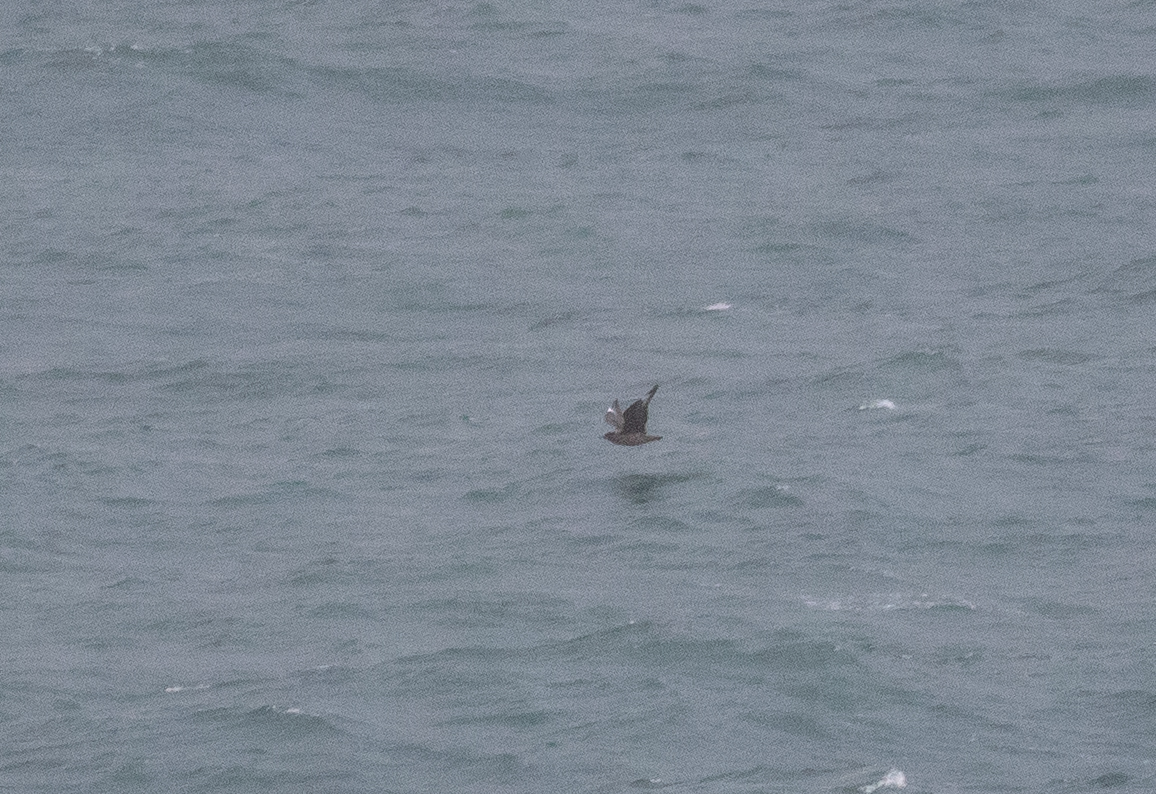
Getting fairly regular now, but still bizarre to get one on a seawatch

One of the 4 Bonxies

All 9 Great Northern Divers will full summer plumaged birds

Other notable bits:

  • Blue-headed Wagtail - a female-type flew south during a vismig on 11th May, picked up in the bins as 'interesting' coming head-on, confirmed as so from flinging the camera in it's direction.

A properly grey head with a bit of a necklace necklace stood out head on in the bins
  • Cuckoo - A patch tick singleton flew south during an evening vismig session on 19th May, mobbed by pretty much everything in the area.
  • Mandarin - It had to be done...when Stewart messaged to say there was a drake on Howick pond on 'Pallid Swift' day, and that he would kindly point it out, I popped across in the evening - certainly one I didn't think was possible in the area.
  • Quail - whilst out looking for Owls at dusk, a few notes burst out of a Barley field near Dunstan
  • Red Kite - distant bird picked up north of Longhoughton from Seaton Pt on 11th May before it dropped down.
  • Scaup - Pair north off Seaton Pt on 2nd May.
  • Redstart and Spotted Flycatcher - Female type on 17th May by the farmhouse at Seaton Pt, with the Spot Fly by Boulmer car park in the paddock.


Looking forward:

Anyone birding within 5km of Longhoughton, feel free to find any of my following, semi-realistic targets for the summer:

  • Ducks - Garganey, Long-tailed Duck.
  • Seabirds - Pom, Black Guillie, Balearic, Great Shear, Cory's, Sab's, Leach's.
  • Passerines - Garden Warbler (I'll get one I'm sure), Tree Pipit, Pied Fly, Green Woodpecker, Crossbill.
  • Waders - Ruff, Curlew Sand, Wood Sand, Little Stint.
  • Yellow-legged Gull.
  • Raptors - Osprey, Hobby, LEO.

I'm sure there's things I've forgotten from that, but they're all doable I reckon. Hopefully the first couple of weeks of June have some easterlies for things like Marsh Warbler and Red-back Shrike, and hopefully some rarities make an appearance. 

Thursday, 29 October 2020

August purple patch

The winds had looked decent for a seawatch on the August 9th, and an early doors Great Shear N past Newbiggin had me looking out for several hours at high tide, with little to show other than a Velvet, a Sooty and 2 Bonxies. I headed off for Seaton Point in search of migrants, and had just reached the farmhouse when I realised I had a missed call from Stewart and John, and checking messages revealed they reckoned they had a good candidate for a lesser goldie just north of the village, on the receding tide where I had been seawatching earlier! 

A 'boc' appeared in our Boulmer group chat, and my reply was "PGP!", then "nailed on get it out". Obviously easier to form a coherent opinion when it's not sitting in front of you, and Stewart and John had already come to the same conclusion. I set off back in a half jog with all my kit, and probably 10 minutes later was scoping the bird on the mud - an absolute cracker, barely a feather out of place and showing very well. An excellent find and a new bird for the area, it gave me a lesson in being more thorough with checking the open areas of the Steel and not just the flock of Golden Plovers and other waders, as it came out it had been photographed a couple of days before. The Plover caused quite a stir, and with it showing well lots came to twitch it. Sooties started becoming daily, even in the wrong  winds, something I've never experienced when seawatching at other sites, whilst Velvet Scoter also increased, starting with 4 N on the 9th. 

Initial views...

The 13th was a great day, a real showcase for the site: I arrived early at the Steel, picking up the PGP quickly with it showing very well in foggy conditions, and with the wind in the east the conditions screamed Black Terns so I set up to do a watch. A GN Diver went south, a trickle of Shearwaters north, and then at 1235 I picked up a marsh tern flying slowly north around 200m offshore. I told a birder sat next to me who was watching the Plover (Adrian Pitches I believe) that I had a moulting adult marsh tern, and that it looked interesting. The most notable feature at the distance I first picked up the at was the striking white area around the leading edge to the upperwing, and although the bird was heavily moulting, overall the blacks seemed blacker and the whites whiter than on any adult Black Tern I'd seen. In case there were other birders in the area on the Northumberland Whatsapp group, I put it out as a probable moulting ad WWBT off the Steel. It was going nowhere fast, so I managed some phonescoped video, below, which all the diagnostic features can be seen in.

Thankfully, the bird came closer as it moved north, and must have clocked the small groups of mixed Terns sat on the Steel, as it came in-off and plonked itself in the flock. Because of it's size, it was initially mostly obscured by a rock, with only it's head showing, but after a brief sortie it landed in a more prominent position, offering good albeit distant views. Another birder arrived on scene, but after around 35 minutes most of the birds on the Steel got up, and we all failed to locate the Tern again. A few birders arrived shortly after, but unfortunately that was the last that was seen of it at Boulmer (it appeared the next day in the Druridge area.) Another first for the area, I believe this addition put the area list on 241. 4 Pomarine and increasing Skua numbers generally, tideline Sooties and juv Black Terns and Little Gulls were noted that afternoon and the next day.


And then came the Long-taileds...

The Plover stuck around long enough for Mark to catch up with it after being away thankfully, and the 16th brought the first highly anticipated Long-tailed Skuas of the year, after a great year for records on the Norther Isles. I managed 8, all juvs north in the afternoon, alongside a Pom, 5 Bonxie and 9 Arctics and a distant large shear S. I won't go into every seawatch, but LTS were had fairly regularly into September, with Juv Black Tern being a feature of most evening watches from the Steel. I had my first Pied Fly at Seaton Point found by Ben, and a juv Curlew Sand on the 22nd, joined by another on the 23rd, and more interestingly a very good (to my eye) juv Fuscus candidate with mostly GBBs in the 2nd field north from the village. 


I've no experience with the species in this plumage but have been fairly well exposed to the fundamentals of their ID through being into gulls generally. The Common Gull like jizz immediately struck me, as the the very pale front and head, delicate beak, long primaries and dark centred scaps, with little notching on any feathers. It really did scream Fuscus to me, and I put it out as a probable - alas without a ring these things never get far. Very interesting none the less, and I even picked it up flying north the next morning after presumably roosting on the sea where it flew to the night before. If nothing else, it was tiny!


The 26th brought 177 PB Brent north (new) alongside a cracking close (and dark this time) Balearic alongside a Manx heading south: 2 juv LTS, 21 Sooty, Black Tern, Little Gull and Roseates made for a nice watch. Sooty numbers were increasing, with routine daily counts of 20, LTS still almost daily as reflected elsewhere and migrant numbers, although low, were enough to keep interest going.

I ended August on 145 for the area, and with around 3 weeks left before I knew I'd be moving to Lincolnshire, reaching the target of 160 by the end of September was going to be close!


Red-eyed Vireo, Seaton Point 15/10/22

 A short write-up of what will probably be my find of the year before the easterlies hit midweek. For the past two weeks, a Nearctic passeri...